
The Universal Declaration of Human Rights
John Humphrey’s 1947 Draft, the 30 Articles, and How a Declaration Became Law
A lawyer from Hampton, New Brunswick, produced the first full draft of the Universal Declaration of Human Rights. John Peters Humphrey was 42 years old, newly appointed as the UN Division of Human Rights’ inaugural director, when he completed a 408-page annotated outline in 1947 that became the committee’s working foundation. Four decades passed before his contribution was confirmed – a McGill University librarian found the handwritten originals in 1988.
The UDHR holds two records as of 2024: the most cited human rights document in existence, and the most translated document of any kind, now rendered in 562 languages. It is not a treaty. The UN General Assembly adopted it on December 10, 1948, as a declaration of principles carrying no direct legal force at the time. Over the 75 years since, that distinction has blurred considerably. The declaration of human rights Canada helped draft is now the foundation of binding treaty law in more than a dozen UN instruments, and the most translated document of any kind.
What Is the Universal Declaration of Human Rights?
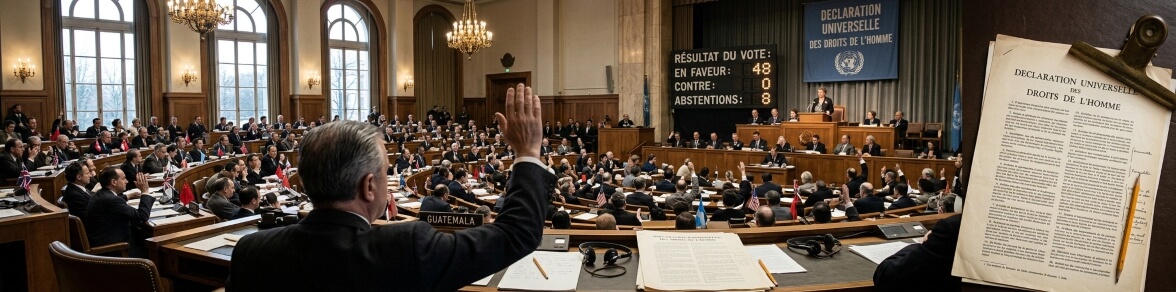
What is the universal declaration definition, exactly? The document adopted at the Palais de Chaillot in Paris on December 10, 1948, UN General Assembly Resolution 217 A (III), is a statement of 30 rights and freedoms that the UN affirmed as belonging to every person on earth. When the vote closed, the tally read 48 in favour, none against, eight abstentions. The six Soviet bloc delegations abstained alongside South Africa and Saudi Arabia. Honduras and Yemen were absent entirely. Canada was in the majority.
The document they adopted, UN General Assembly Resolution 217 A (III), set out 30 articles affirming that certain rights belong to every person on earth, without qualification by nationality, race, sex, religion, or anything else. Eleanor Roosevelt, who led the drafting committee, described it as the international equivalent of Magna Carta. The language was deliberately ambitious. The Declaration imposed no legal obligations. It established no enforcement body. What it created was a shared standard articulated publicly, voted on by governments, and placed permanently in the record.
Standards have a way of generating law. The UDHR’s preamble called it “a common standard of achievement for all peoples and all nations,” and that framing proved accurate in a direction the drafters may not have fully anticipated. The International Covenants of 1966 converted its civil, political, economic, and social provisions into binding treaty obligations. CEDAW, the CRC, and a dozen other treaties drew directly on its text. The UDHR’s own core provisions, the prohibitions on torture and slavery, the right to life, the bar on arbitrary detention, are now so uniformly applied by national and international courts that they are widely treated as customary international law: binding on all states whether or not they ever voted for the document.
Eleanor Roosevelt described the UDHR as the international Magna Carta. When it passed, that was rhetoric. Over 75 years of consistent state practice, it has become something considerably closer to law.
John Humphrey and Canada’s Role in Drafting the UDHR
John Peters Humphrey was born on April 30, 1905, in Hampton, New Brunswick. His childhood was hard. His father died when he was thirteen months old. His left arm was amputated at age seven following a fire accident. Both parents were gone by the time he was eleven. He went on to earn a B.Com, a BA, and an LLB from McGill University, then a Master of Laws specializing in international law, and eventually a teaching position on McGill’s law faculty.
The Fateful Tea
In 1946, Henri Laugier – a French academic who had taught at McGill during the Nazi occupation, and who had become friendly with Humphrey during those years – was appointed UN Assistant Secretary-General for Social Affairs. He offered Humphrey the job of first Director of the UN Division of Human Rights. Humphrey accepted.
In January 1947, Eleanor Roosevelt, as chair of the UN Commission on Human Rights, invited a small group – including Humphrey, Charles Malik of Lebanon, and Peng Chung Chang of China – to tea at her apartment on Washington Square in New York. Before tea was over, it was decided that Humphrey would prepare the preliminary draft. By his own account, he was not especially charismatic or an original thinker. What he had was the legal and linguistic range to synthesize an enormous amount of material, and the institutional position to do it.
The 408-Page Outline
Humphrey’s Secretariat Outline was completed by April 1947. It was 408 pages long. It surveyed constitutions, legal traditions, and draft rights declarations from across the world, assembled into a working framework that proposed 48 articles and four preambles. The spirit of one preamble survived into the final text: “Whereas recognition of the inherent dignity and of the equal and inalienable rights of all members of the human family is the foundation of freedom, justice and peace in the world.”
That Outline was then handed to René Cassin of France, who restructured and revised it. Cassin later claimed primary authorship of the first draft – a claim that aligned conveniently with his Nobel Peace Prize in 1968. It stood unchallenged for twenty years. In 1988, A. J. Hobbins, a law librarian at McGill, was searching Humphrey’s files for lecture notes when he came across handwritten papers that turned out to be Humphrey’s original draft. Hobbins published his findings in an academic journal. Humphrey’s role entered the historical record, officially, at the age of 83.
Humphrey served as Director of the UN Division of Human Rights for twenty years, overseeing the development of 67 international conventions. He received the Order of Canada in 1974, the UN Human Rights Prize in 1988, and – in September 1998, at the UN Human Rights Monument in Ottawa – Nelson Mandela called him “the father of the modern human rights system.” Humphrey had died three years earlier, on March 14, 1995. He knew his role had been recognized; he died having seen Canada mark the 50th anniversary of the document he had drafted.
A note on Humphrey’s working method
Humphrey was not working from nothing. He analysed 48 national constitutions and draft declarations from NGOs and governments worldwide. His document was synthesis, not invention, and synthesis was exactly what the moment required. The UDHR’s strength is its rootedness in multiple legal and cultural traditions, not in any single one. That was Humphrey’s contribution: making the document less Western than it might otherwise have been.
The 30 Articles: Structure and Key Provisions
The final UDHR contains 30 articles – eighteen fewer than Humphrey’s original draft of 48. The drafting process compressed, combined, and in some cases eliminated provisions. What remained was organized into a coherent structure that moves from foundational principles through civil and political rights, then economic and social rights, then a closing framework.
Articles | Category | Key rights covered |
|---|---|---|
Arts. 1–2 | Foundations | All people are born free and equal in dignity and rights; rights apply without distinction of any kind |
Arts. 3–21 | Civil and political rights | Right to life, liberty, security; freedom from torture, slavery, arbitrary arrest; fair trial; privacy; freedom of thought, conscience, religion, expression, assembly; right to vote and take part in government |
Arts. 22–27 | Economic, social and cultural rights | Right to social security, work, equal pay, rest and leisure, education, participation in cultural life; right to an adequate standard of living |
Arts. 28–30 | Framework | Right to a social and international order in which rights can be realized; duties to the community; no state or group may act to destroy any right in the Declaration |
A few provisions deserve particular attention. Article 1, “All human beings are born free and equal in dignity and rights”, is among the most quoted sentences in international law. Article 5 absolutely prohibits torture and cruel, inhuman or degrading treatment. Articles 10 and 11 establish the right to a fair trial. Article 18 protects freedom of thought, conscience and religion. Article 19 protects freedom of opinion and expression. Article 26 provides for the right to education.
One structural choice in the UDHR was deliberate and, at the time, contested: the inclusion of both civil/political rights and economic/social rights in the same document. Western states generally preferred to limit the declaration to the former. The Soviet bloc pushed hard for the latter. Both were included. When the rights were later codified into binding treaties in 1966, they were split into two separate covenants precisely because this compromise had not resolved the underlying political disagreement.
From Declaration to Binding Law: How the UDHR’s Legal Status Changed
When Eleanor Roosevelt addressed the General Assembly on December 9, 1948, she was direct: the text before them was not a treaty and not an international agreement. She was describing it accurately. The question worth asking now, seventy-five years later, is whether that description still captures the full picture.
Customary International Law
Customary international law forms when two conditions are met: states follow a practice consistently, and they do so because they believe themselves legally required to, not merely because it is convenient or expected. Tested against that standard, the UDHR’s central provisions have crossed the threshold. The prohibitions on torture, slavery, and arbitrary detention; the right to life.
The bar on discrimination, these appear in the judgments of domestic courts and international tribunals so regularly, and are reaffirmed in UN instruments so continuously, that their customary status is no longer seriously contested. The OHCHR put it plainly: the document has moved from aspiration to a set of standards embedded across virtually every domain of international law.
The Codification Path
The most direct path from the UDHR to binding obligation ran through Geneva in 1966. The International Covenant on Civil and Political Rights and the International Covenant on Economic, Social and Cultural Rights took the Declaration’s provisions and recast them as treaty commitments, enforceable through monitoring bodies and, for the ICCPR, through individual complaints. Together with the UDHR, those two instruments form what lawyers in the field call the International Bill of Human Rights. Canada ratified both covenants in 1976. The UDHR served the same foundation-laying function for CEDAW, the Convention on the Rights of the Child, and most of the core UN human rights treaties that followed.
In Canadian courts, the UDHR occupies an interpretive role. It carries no independent enforcement power, a Canadian cannot invoke it directly before a domestic tribunal to found a claim. What it does is illuminate the scope of rights that the Charter and federal and provincial human rights legislation are understood to protect. Courts have drawn on it when the meaning of a domestic provision is uncertain.
Human Rights Day and Canada
Since 1965, December 10 has been marked annually as Human Rights Day – fixed to the date the General Assembly voted. The vote itself came four minutes before midnight. The final count was 48 in favour, none against.
Canada observes Human Rights Day each year through government events and statements coordinated by the Department of Canadian Heritage. In New Brunswick, the province where Humphrey grew up, the John Peters Humphrey Foundation maintains programming around his legacy. A bronze statue installed in Hampton in 2023, the UDHR’s 75th anniversary year, gives his hometown a permanent marker.
What Human Rights Day asks of us, practically, is to look at the document itself and then at what grew from it. The Declaration established the vocabulary and the standard. The covenants and conventions ratified by Canada over the following decades gave that standard legal force. The Declaration matters because what came after it matters. The difference between an aspiration and an obligation is real, and understanding it is the point.
Sources: New Brunswick Human Rights Commission (John Peters Humphrey) • Wikipedia: John Peters Humphrey (January 2026) • Wikipedia: Universal Declaration of Human Rights • UN Dag Hammarsköld Library – Drafting Committee Research Guide • UN History of the Declaration • Defining Moments Canada • Active History (December 2023) • Oxford Public International Law: UDHR • Grokipedia: John Peters Humphrey (January 2026) • Canadian Museum for Human Rights