
The Rome Statute and the ICC: Canada’s Founding Role & Legal Obligations
Canada’s Role in Creating the ICC and Its Obligations under the Rome Statute
Jurisdiction over individuals charged with genocide, war crimes, and crimes against humanity does not arise automatically. For the 125 states that have joined the International Criminal Court, it rests on a treaty, one whose final text was hammered out across five weeks in Rome and put to a vote on the evening of July 17, 1998.
Canada’s relationship to that moment is not that of a passive signatory. Canadian diplomats chaired the coalition that shaped the statute’s core architecture. Canadian legislation implementing those obligations reached Royal Assent before ratification was complete. No other state moved that fast.
The Road to a Permanent Court: Nuremberg, Stalled Drafts, and Rome
The Nuremberg tribunal sat for less than a year. Its indictments were filed on October 18, 1945; the verdicts came on October 1, 1946. Twelve defendants were sentenced to death. The Tokyo trials ran longer, from May 1946 to November 1948, and produced 25 convictions. Both tribunals were created after the fact, by the victors, for the crimes of the defeated. The question of whether something more permanent and more neutral was possible had been on international law’s agenda ever since.
The ILC’s Long Road
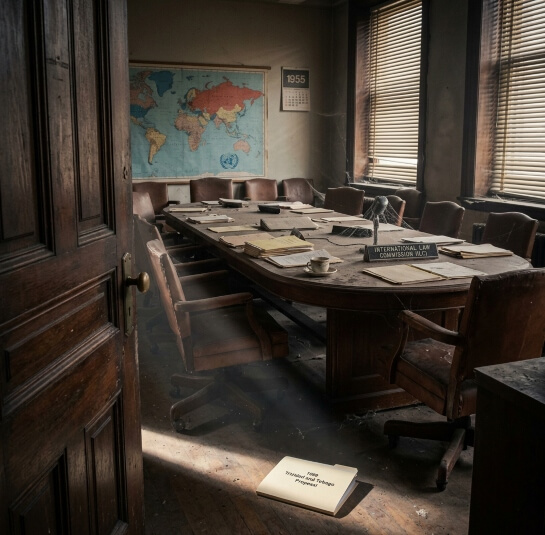
The idea of a standing international criminal court did not arrive in 1998. The International Law Commission placed it on its working agenda in 1950. Draft statutes appeared in 1951 and again in 1955. Neither went anywhere. The political arithmetic of the Cold War made the project effectively untouchable – a permanent tribunal with an independent prosecutor would eventually reach questions neither Washington nor Moscow wished examined, and both had the influence to keep it dormant. For more than thirty years, it stayed that way.
The opening came from an unexpected direction. In 1989, Trinidad and Tobago asked the UN General Assembly to revisit the idea – the goal was a court to prosecute international drug trafficking, not atrocity crimes. The General Assembly asked the ILC to pick up where it had left off. Working under the direction of special rapporteur James Crawford, an Australian international law scholar, the International Law Commission (ILC) 1994 draft statute was completed – the document that became the direct working text for Rome. UN General Assembly Resolution 49/53 of December 9 that year called for a diplomatic conference to be held.
Meanwhile, two conflicts were making the theoretical concrete. The Security Council established the International Criminal Tribunal for the former Yugoslavia in 1993 and the International Criminal Tribunal for Rwanda in 1994, both responding to mass atrocities, both created after the fact for a single situation. The tribunals produced real work and real convictions. They also exposed what ad hoc justice costs: years, hundreds of millions of dollars, and a mandate that dissolved the moment a specific conflict was deemed resolved. A court that had to be rebuilt for each crisis was not a solution.
The Preparatory Committee, 1996–1998
From 1996 to 1998, six sessions of the UN Preparatory Committee in New York worked through the ILC’s 1994 draft article by article. This is where the Like-Minded Group coalesced. Roughly 60 states, from Argentina to Zimbabwe, with Canada at the chair, shared a common position: an independent prosecutor, reduced Security Council control, automatic jurisdiction over the core crimes. In January 1998, a technical inter-sessional meeting in Zutphen, the Netherlands, consolidated the draft into a structured negotiating text. The Rome Conference followed five months later.
The 1998 Rome Conference and Canada’s Role
The UN Conference of Plenipotentiaries on the Establishment of an International Criminal Court opened in Rome on June 15, 1998. More than 160 governments participated. Five weeks of intense negotiations followed. The final vote, on July 17, was 120 in favour, 7 against, and 21 abstentions.
Philippe Kirsch and the Committee of the Whole
Canada’s diplomatic role was concentrated in one person: Philippe Kirsch, the Legal Adviser to Canada’s Ministry of Foreign Affairs. Kirsch had been sent to Rome as head of the Canadian delegation and chairman of the Like-Minded Group. The plan changed when the Preparatory Committee chair, Adriaan Bos of the Netherlands, fell seriously ill. Bos had been expected to chair the Committee of the Whole – the pivotal negotiating body at the conference. Kirsch stepped in. He was chosen by acclamation.
What followed over five weeks was exceptionally demanding. The Committee of the Whole had to resolve hundreds of unresolved technical points, and beneath those lay several genuinely intractable political ones: the scope of jurisdiction, the relationship between the Court and the UN Security Council, and the definition of crimes. Kirsch’s response, on the final morning of the conference, was to draft and present a take-it-or-leave-it global package, a carefully balanced text that reflected the majority position on a strong, independent ICC while making every possible accommodation to minority views. It held. The final vote was 120 to 7.
What Canada’s Like-Minded Group Achieved
The LMG’s core goals were structural: an independent prosecutor who could initiate investigations without a state referral, automatic jurisdiction over genocide and crimes against humanity for states that ratified (not opt-in jurisdiction), and limits on the Security Council’s ability to block prosecutions. All three were incorporated into the final statute, though with compromises. The proprio motu power requires Pre-Trial Chamber authorization. Article 16 allows the Security Council to defer investigations for renewable twelve-month periods. These were the concessions that kept the broadest coalition on board.
Canada chaired a coalition of nearly 60 states at Rome called the Like-Minded Group. Their core demand: a prosecutor independent of the Security Council. They got it, with constraints.
Structure of the Rome Statute: Jurisdiction and Key Articles
The Rome Statute runs to 128 articles and 13 parts. What follows is the architecture that matters most for understanding how the Court actually works.
Article 17 and the Complementarity Principle
Complementarity is the Rome Statute’s central operating concept, and the one most frequently misread. The ICC was not designed to displace national criminal systems. It was designed to fill the gaps they leave. Under Article 17, the Court must decline jurisdiction if a national system with authority over the case is genuinely pursuing it. The ICC becomes available only when that national pursuit is absent, collapsed, or a pretence. For Canada, this is not an abstract point. The Crimes Against Humanity and War Crimes Act exists precisely to keep Canadian courts in the primary position – the ICC is the fallback, not the default.
How the Court Acquires Jurisdiction
Three paths lead to ICC jurisdiction. A state party may refer a situation to the Prosecutor. The UN Security Council may refer a situation – a mechanism that reaches even non-member states, since it flows from the Council’s Chapter VII authority rather than treaty consent. Or the Prosecutor may open an investigation independently, without any referral, under the proprio motu power – subject to authorization from a Pre-Trial Chamber. In practice, self-initiated investigations have outnumbered referrals. Among the state referrals that have occurred, most came from the affected states themselves, governments acknowledging that their own systems could not handle the cases.
The Four Crimes (Article 5)
Article 5 defines the Court’s subject-matter jurisdiction. Four categories of crime fall within it. The crime of aggression was listed from the start but left undefined; the Kampala Review Conference supplied the definition in 2010, and the jurisdiction to prosecute it did not become operational until 2018.
Crime | Article | Definition (summary) |
|---|---|---|
Genocide | Article 6 | Any of five specified acts carried out with intent to destroy a national, ethnic, racial, or religious group – the same definition as the 1948 Genocide Convention |
Crimes against humanity | Article 7 | Acts including murder, torture, rape, enforced disappearance, and deportation, committed as part of a widespread or systematic attack directed at a civilian population |
War crimes | Article 8 | Grave breaches of the Geneva Conventions and other serious violations of the laws of armed conflict, in both international and non-international conflicts |
Crime of aggression | Article 8 bis | Planning, preparation, initiation, or execution of an act of aggression by a person in effective control of state action. Prosecutable from 2018 |
Canada’s Implementation: The Crimes Against Humanity and War Crimes Act
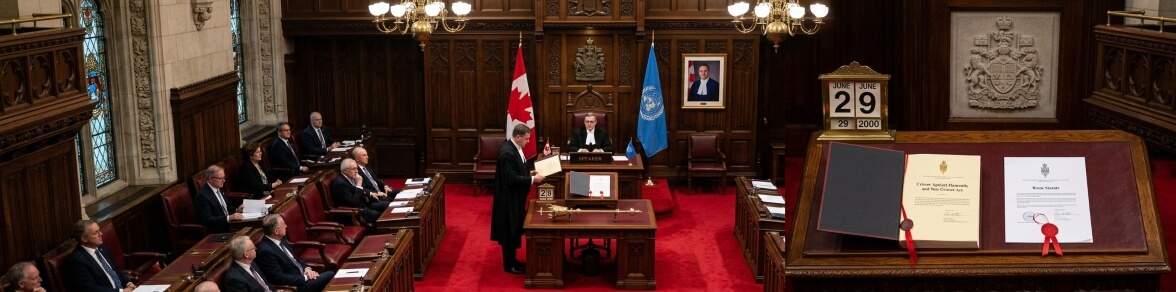
Canada did something unusual. Before ratifying the Rome Statute, we passed the implementing legislation. The Crimes Against Humanity and War Crimes Act (S.C. 2000, c. 24) received Royal Assent on June 29, 2000. Canada ratified the Rome Statute eleven days later, on July 9, 2000. Canada was the first state in the world to enact domestic implementing legislation for the Rome Statute.
The Act does several things. It creates criminal offences in Canadian law for genocide, crimes against humanity, and war crimes as defined in the Rome Statute. It establishes jurisdiction over offences committed abroad, where the accused or victim is a Canadian citizen or national, or where the accused is present in Canada. It implements the command responsibility doctrine: superior officers can be prosecuted for crimes committed by subordinates if they knew or should have known and failed to prevent. Penalties run up to life imprisonment.
The Act also protects the ICC’s processes directly. It makes obstruction of ICC proceedings, interference with witnesses, and assaults on ICC officials criminal offences under Canadian law. This was one of Canada’s specific contributions to the implementation model – going beyond the minimum the Statute requires.
Philippe Kirsch’s later career
After his role at Rome, Kirsch was elected as an ICC judge in February 2003 and subsequently served as the Court’s first president until 2009. Another Canadian, Kimberly Prost, was elected as an ICC judge in December 2017 for a nine-year term. In August 2025, Prost was among the ICC officials sanctioned by the United States government in response to the Court’s arrest warrants related to the conflict in Gaza.
The ICC and Its Limits: Non-Member States and the Enforcement Gap
As of January 2025, 125 states are parties to the Rome Statute. That leaves around 70 states outside, including three permanent members of the UN Security Council: the United States, Russia, and China. None of the three has ratified. China never signed. The United States signed in 2000 under President Clinton but withdrew its signature in May 2002 under President George W. Bush. Russia signed in 2000 and withdrew its signature in 2016.
What Non-Membership Means
The ICC cannot automatically exercise jurisdiction over crimes committed by nationals of non-member states on the territory of non-member states. The exception is a UN Security Council referral, but Russia and China hold veto power there. The Court can investigate crimes committed on the territory of a state that has accepted jurisdiction, or where a state party itself refers a situation. Ukraine, not a Rome Statute party, accepted ICC jurisdiction ad hoc in 2014; this is how the Court issued arrest warrants for Russian officials including President Putin in March 2023.
The Enforcement Crisis of 2024–2025
The ICC’s structural weakness, it has no police force and must rely entirely on states to execute arrest warrants, became visible in an unusually direct way from late 2024 onward. In November 2024, the Court issued arrest warrants for Israeli Prime Minister Benjamin Netanyahu and former Defence Minister Yoav Gallant. In April 2025, Hungary, an EU member state and Rome Statute party, hosted Netanyahu, in deliberate defiance of its treaty obligation to arrest him. Hungary subsequently announced its withdrawal from the Rome Statute.
The United States imposed sanctions on ICC officials in February 2025, citing the Court’s actions as “abuses of power.” Russia, in December 2025, convicted ICC Prosecutor Karim Khan and eight ICC judges in absentia in a Moscow court. In September 2025, Burkina Faso, Niger, and Mali announced withdrawal. None of these developments changes Canada’s obligations as a state party, but they are directly relevant to understanding what international criminal justice depends on in practice: the willingness of states to cooperate. That willingness is not guaranteed.
Canada’s position in 2026
Canada has maintained its support for the ICC and has not joined the US sanctions regime. The Canadian government has publicly reaffirmed its commitment to the Rome Statute framework. The sanctioning of Canadian judge Kimberly Prost by the United States in August 2025 drew a formal statement of concern from Ottawa.
Sources: ICC-ASP • Coalition for the International Criminal Court • EBSCO Research Starters • Cambridge Core (Yearbook of International Humanitarian Law) • Canada and the ICC – Global Affairs Canada • Crimes Against Humanity and War Crimes Act SC 2000 c. 24 – Justice Canada • Wikipedia: States parties to the Rome Statute (updated April 2026) • Council on Foreign Relations, ICC Backgrounder (March 2026) • Global Policy Journal (January 2026)