
Inter-American Human Rights: Declaration, Pact of San José, and Canada’s Legal Status
Declaration, Convention, and Canada’s Position
Two instruments form the legal backbone of human rights in the Americas. The first is the American Declaration of the Rights and Duties of Man, adopted in Bogotá in May 1948 – the first international human rights document of any kind. The second is the American Convention on Human Rights, concluded in San José in 1969 and binding as a treaty since 1978. Canada operates under one and not the other. It accepted the obligations of the American Declaration when it joined the Organization of American States in 1990. It has never signed the Convention.
That gap is not merely procedural. It determines which monitoring bodies can act on complaints against Canada, what rights framework applies, and whether the Inter-American Court has any jurisdiction at all. For anyone researching hemispheric human rights, whether as a practitioner, a journalist, a scholar, or a policy analyst, the distinction is the starting point.
American Declaration (1948) | American Convention (1969) | |
|---|---|---|
Adopted | May 2, 1948 (Bogotá) | November 22, 1969 (San José) |
In force | Binding via OAS Charter/practice | July 18, 1978 |
Nature | Declaration (non-binding at adoption; binding by practice for OAS members) | Binding treaty |
Monitoring body | IACHR (Washington, D.C.) | IACHR + IACtHR (San José) |
Individual petitions | Yes (under the Declaration only) | Yes (under the Convention + IACtHR referral) |
Canada bound? | Yes | No (not ratified) |
Rights scope | Rights and duties (28 articles each) | Rights only; no explicit duties chapter |
Economic/social rights | Yes (Articles XI–XVI) | Via Protocol of San Salvador (1999) |
The 1948 American Declaration of the Rights and Duties of Man
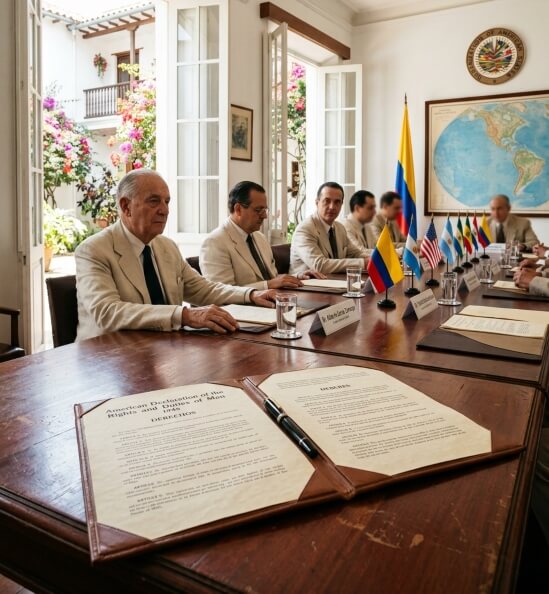
On May 2, 1948, seven months before the Universal Declaration of Human Rights, the Ninth International Conference of American States in Bogotá, Colombia, adopted the American Declaration of the Rights and Duties of Man. It was the first international human rights instrument ever adopted, at any level. The UDHR followed in December.
Two features distinguish the American Declaration from the UDHR. First, it includes a chapter on duties alongside rights – Articles XXIX through XXXVIII set out the individual’s duties to society, to children and parents, to education, to vote, to work, to pay taxes. This rights-and-duties structure reflects the Latin American legal tradition’s emphasis on the social embeddedness of rights. Second, the Declaration was adopted as a declaration, not a treaty, formally non-binding at the time.
From Declaration to Binding Obligation
The American Declaration carried no treaty status when it was adopted. That changed through institutional interpretation rather than any new agreement. The Inter-American Commission developed the position, over the 1960s and 1970s, that OAS membership itself, through the human rights language in the OAS Charter, made the Declaration’s standards binding on all member states. The Inter-American Court put this on firmer legal ground in Advisory Opinion OC-10/89 (1989): the Declaration carries binding force for OAS members regardless of whether they have signed the American Convention.
For Canada, which joined the OAS on January 8, 1990 without signing the Convention, the Declaration is therefore the operative human rights standard – the document under which IACHR complaints against Canada are assessed.
The Declaration pairs rights with duties. Its 28 rights articles cover the right to life, liberty and personal security (Article I), equality before the law (Article II), freedom of religion (Article III), freedom of expression and assembly (Articles IV–XXI), and social rights to health, education, and work (Articles XI–XVI). Ten further articles address individual duties to society, family, civic participation, and the state.
The American Convention on Human Rights (Pact of San José)
A diplomatic conference convened in San José, Costa Rica produced the American Convention on Human Rights on November 22, 1969. The city gave the treaty its common alternative name: the Pact of San José. Nine years passed before it reached the threshold for entry into force – that happened on July 18, 1978, when Grenada became the eleventh state to deposit its instrument of ratification.
The Convention brought two oversight bodies into the picture, though only one of them was new. The Inter-American Commission on Human Rights had already existed since 1959, created by the OAS nearly a decade before the Convention. Its headquarters remain in Washington, D.C. The Commission monitors human rights in all 35 OAS member states, those that have ratified the Convention and those that have not, working under both instruments simultaneously. The Inter-American Court of Human Rights is a different matter. The Convention created it, and the Court draws its authority entirely from the Convention. A state must have ratified the treaty and separately accepted the Court’s contentious jurisdiction before the Court can hear cases against it. Neither condition applies to Canada.
What the Convention Adds
The Convention covers most civil and political rights found in the ICCPR, but with differences. It includes a right to property (Article 21) absent from the ICCPR. It includes a right of reply (Article 14) for individuals aggrieved by inaccurate or offensive statements in the media – a provision with no direct ICCPR equivalent. Its death penalty provisions are stricter than those in any UN treaty. The Convention also prohibits, in Article 22, collective expulsion of aliens.
Economic, social and cultural rights are addressed separately in the Additional Protocol to the American Convention (the Protocol of San Salvador), adopted in 1988 and in force since 1999. It covers the right to work, health, food, education, and a healthy environment.
As of 2025, 25 OAS member states have ratified the American Convention. The United States has signed but not ratified it. Canada has not signed or ratified.
Canada and the Inter-American System: Membership Without Full Ratification
Canada joined the OAS as a full member on January 8, 1990, under Prime Minister Brian Mulroney’s government. Before that, Canada had held observer status since 1972 but had long maintained that its relations with Latin America were limited enough that full membership was not a priority. The decision changed in the late 1980s as the Mulroney government sought expanded economic and diplomatic ties in the hemisphere.
What Canada Accepted by Joining
By ratifying the OAS Charter, Canada accepted the binding obligations of the American Declaration and the competence of the IACHR to monitor its human rights record. The IACHR can receive individual petitions against Canada, but only alleging violations of the American Declaration, not the Convention. Canada has never accepted the contentious jurisdiction of the Inter-American Court, and cannot until it ratifies the Convention.
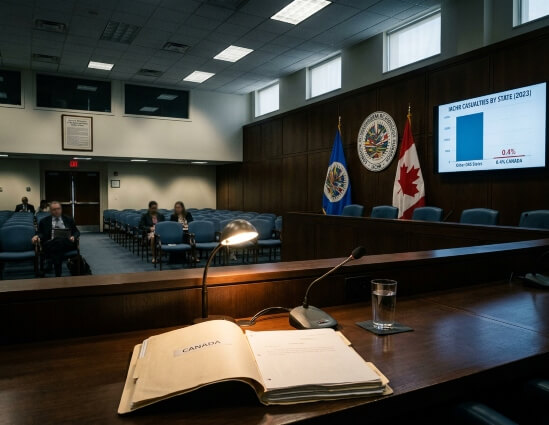
Individual actions against Canada before the IACHR have been rare. Petitions against Canada account for approximately 0.4% of total submissions to the Commission. The IACHR has issued three decisions on the merits involving Canada and has published two thematic reports on Canada, including one on the refugee determination system following an on-site visit. These proceedings operate under the American Declaration as Canada’s applicable standard.
Why Canada Has Not Ratified the Convention
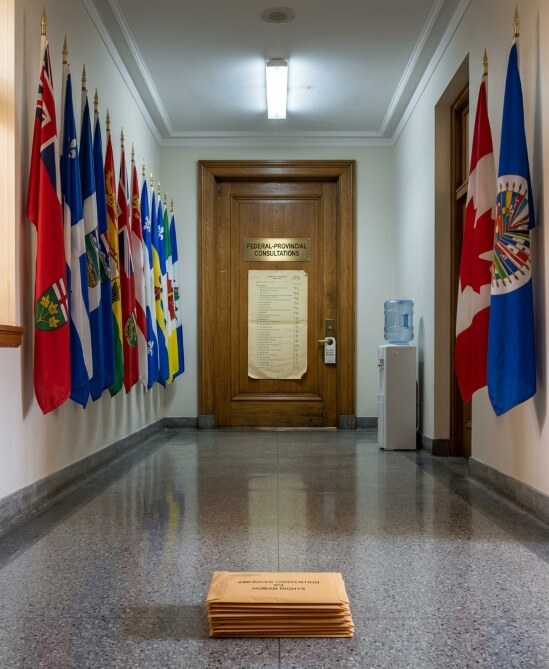
Consultations between the federal government and the provinces on compliance with the American Convention’s obligations began in 1991 and have continued without resolution. When then-Foreign Affairs Minister Lloyd Axworthy was asked in the House of Commons in 1999 why Canada had not ratified, he said: “Before Canada can ratify a human rights convention, we must ensure that we are in a position to live up to the commitments we would undertake by ratifying it.” That position has not materially changed.
The identified complications include the Convention’s stronger right-to-life provision (Article 4), which some argue could conflict with Canadian law on medical assistance in dying; concerns about the IACtHR’s “creative” remedies beyond compensation; and the federal-provincial division of jurisdiction over human rights. No government has publicly committed to ratification as a policy goal.
Canada is bound by the American Declaration as an OAS member. But it has not accepted the American Convention, and therefore the Inter-American Court has no jurisdiction over Canada. Canadian complaints go to the IACHR only, and only under the Declaration.
The IACHR and the IACtHR: Two Bodies, Two Roles
The distinction between the two monitoring bodies is frequently confused. They are separate institutions with different mandates.
Inter-American Commission on Human Rights (IACHR)
The IACHR, based in Washington, D.C., monitors the human rights situation in all 35 OAS member states. It receives individual petitions, conducts country visits, issues thematic reports, and can refer cases to the Inter-American Court, but only for states that have ratified the Convention and accepted contentious jurisdiction. For non-Convention states like Canada, the Commission’s role ends at recommendations; it cannot refer the case to the Court.
Inter-American Court of Human Rights (IACtHR)
The IACtHR, seated in San José, Costa Rica, has two functions. Its contentious function involves binding judgments on individual cases referred by the Commission. Its advisory function allows OAS member states and organs to request interpretations of the Convention and other human rights treaties. Advisory opinions are not formally binding in the same way as judgments, but carry significant interpretive authority and apply across the OAS membership. Canada, as an OAS member, is subject to the authority of advisory opinions even without having ratified the Convention.
Rights Protected and the 2025 Climate Advisory Opinion
The inter-American system has historically been strongest in its civil and political rights jurisprudence – enforced disappearances, extrajudicial killings, detention without trial. But its advisory opinion function has expanded the system’s reach significantly, most recently into climate rights.
Advisory Opinion OC-32/25: Climate Emergency and Human Rights
On July 3, 2025, the Inter-American Court issued Advisory Opinion OC-32/25 on “Climate Emergency and Human Rights” – the most significant and far-reaching climate rights ruling issued by any international court to date. Requested by Chile and Colombia, the 234-page opinion is the longest in the IACtHR’s history. It was preceded by the most participatory proceedings the Court has ever conducted: 263 written submissions from 613 actors, with hearings in Bridgetown (Barbados), Brasília, and Manaus (Brazil).
The opinion’s central finding: the obligation not to cause irreversible harm to the climate and environment constitutes a jus cogens norm – a peremptory rule of international law that is binding on all states regardless of consent, in the same category as prohibitions on genocide and torture. States must adopt ambitious, science-based mitigation targets; regulate corporate conduct; ensure access to climate information; and protect rights defenders working on environmental issues.
The advisory opinion interprets the American Convention. But its jus cogens conclusion, and its broader analysis of climate obligations under general international law, have implications well beyond the OAS. This is why it has been cited by climate litigants and international courts globally, and why the Yale Climate Connections article that links to this domain used the American Convention as its key authority when reporting on the ruling.
Canada, as an OAS member, is subject to the interpretive authority of IACtHR advisory opinions. The Court’s doctrine of “conventionality control” – which obliges all branches of government in OAS states to align their laws and practices with the Convention – has not been accepted by Canada, given its non-ratification. But the opinion’s customary law conclusions are not so easily set aside.
OC-32/25 and Canada
Canada is an OAS member but has not ratified the American Convention and has never accepted the Inter-American Court’s jurisdiction. Advisory Opinion OC-32/25 formally applies to OAS member states, but Canada’s exposure under it differs from states party to the Convention. The opinion’s findings on jus cogens and customary international law, however, apply to all states regardless of treaty status.
Rights distinctive to the American Convention
Two rights in the American Convention have no direct equivalent in the ICCPR: the right to property (Article 21) and the right of reply (Article 14). The Convention also explicitly prohibits the collective expulsion of aliens (Article 22) and contains stronger restrictions on the death penalty than any UN instrument. These distinctions are why compliance assessment is more complex than a simple comparison with Canada’s UN treaty obligations.
Sources: OAS • IACHR Basic Documents • Senate Standing Committee on Human Rights: Canadian Adherence to the ACHR (May 2003) • Canadian Yearbook of International Law Vol. 30 (1993) • McGill Human Rights Internship Program Blog (2019/2021) • CIEL: IACtHR Advisory Opinion OC-32/25 (November 2025) • CEJIL (July 2025) • EJIL:Talk! (July 2025) • SDG Knowledge Hub (July 2025) • Wikipedia: American Convention on Human Rights