
The Helsinki Final Act, 1975
Security, Cooperation, and Human Rights in Europe and Canada
In August 1975, the leaders of 35 states, including Canada, gathered in Helsinki to sign one of the Cold War’s most consequential diplomatic agreements. The Helsinki Final Act was not a binding treaty. But its third “basket” on human rights would become a powerful tool for civil society across Eastern Europe, and eventually a contributing factor in the end of the Cold War itself.
What makes the document striking, in retrospect, is the gap between what its authors intended and what it became. The Soviet Union had pushed for a European security conference since 1954, seeking formal Western recognition of postwar borders. The West resisted for twenty years. When the agreement finally came, the Soviets got their borders. The West got Basket III.
What Was the Helsinki Final Act?
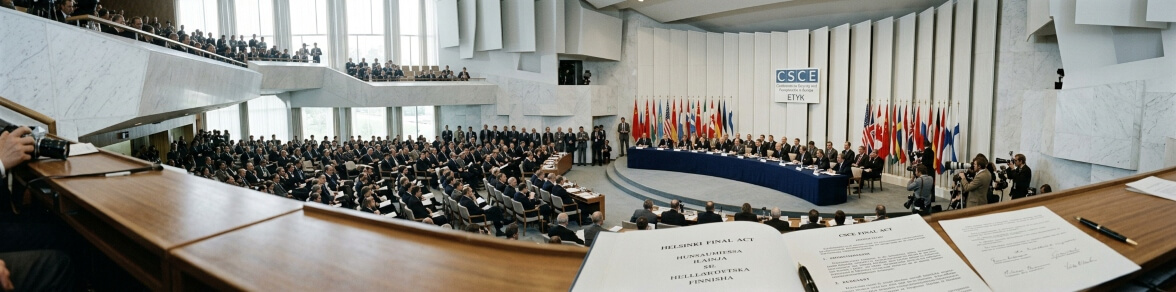
The Conference on Security and Co-operation in Europe (CSCE) opened formally in Helsinki in July 1973, moved to Geneva for two years of negotiations, and returned to Helsinki for the signing summit on July 30 to August 1, 1975. Every European state except Albania signed the Final Act, along with the United States and Canada – 35 participating states in total. Heads of government or state were present: Leonid Brezhnev for the USSR, Gerald Ford for the United States, and Pierre Elliott Trudeau for Canada.
The Final Act was explicitly not a legally binding treaty. The OSCE itself describes the commitments as “politically binding.” It could not be registered with the United Nations Treaty Collection. Its signatories assumed moral and political, not legal, obligations. That non-binding status was, perversely, part of its strength: it allowed states to sign without requiring parliamentary ratification, and it gave dissidents a standard to invoke without triggering sovereignty objections.
The document is organized around three main dimensions, colloquially known as “baskets,” plus a short procedural section on follow-up meetings.
Basket | Subject | Key content |
|---|---|---|
Basket I (First Dimension) | Security in Europe | Ten principles (the “Decalogue”): sovereign equality, inviolability of frontiers, territorial integrity, non-intervention, human rights, self-determination. Also: confidence-building measures, including advance notice of military exercises |
Basket II (Second Dimension) | Economics, science and environment | Trade relations, industrial cooperation, science and technology exchanges, environmental protection |
Basket III (Third Dimension) | Humanitarian issues | Human contacts; family reunification; freedom of movement; conditions for journalists; cultural and educational exchanges; freedom of information |
Basket III: Human Rights Provisions and Their Impact
Basket III was, at the time of signing, the part that the Soviet bloc was least interested in and the West was most interested in. It committed participating states to facilitate the movement of people across borders – family reunification, visits between divided families, and emigration. It protected the working conditions of journalists. It promoted cultural and educational exchanges. Most significantly, Principle VII of the Basket I Decalogue, which is technically in the first basket but is the human rights centrepiece of the whole document, committed states to “respect human rights and fundamental freedoms, including the freedom of thought, conscience, religion or belief,” and explicitly referenced the UDHR and the ICCPR.
The Helsinki Groups
Within months of the signing, something the Soviets had not anticipated happened. Citizens in Eastern Europe and the Soviet Union formed monitoring groups (the “Helsinki Groups”) to document state non-compliance with the commitments in Basket III. Eleven such groups formed in the USSR alone. The Soviet government’s response was to arrest most of their leaders. This produced the opposite of the intended effect: the arrests generated international attention, and Western governments used the review process built into the Final Act to raise compliance at every follow-up conference.
In the United States, a parallel monitoring organization formed in 1978: Helsinki Watch. It operated alongside the CSCE process, documenting abuses and publishing reports that Western governments could use in CSCE meetings. Helsinki Watch later expanded its mandate globally, eventually becoming Human Rights Watch – one of the world’s largest human rights organizations. Its origins lie in the monitoring work triggered by Basket III.
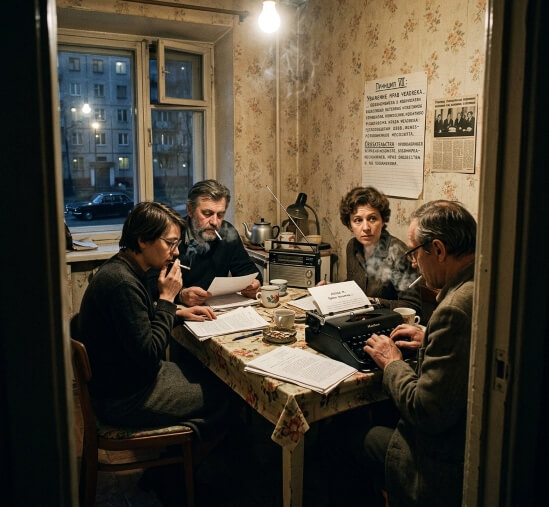
The Soviet Union wanted recognition of its borders. It got that. What it did not anticipate was that Basket III would give Eastern European dissidents an internationally recognized standard to hold their governments to. The Helsinki process was meant to stabilize the Cold War. It helped end it.
Canada as a CSCE Participating State
Canada’s position at Helsinki was somewhat unusual. Geographically outside Europe, Canada had significant domestic stakes in the conference: large communities of Baltic, Ukrainian, Polish, and other Eastern European heritage were watching closely whether Western leaders would effectively legitimize Soviet domination of their homelands by accepting the border-inviolability provisions.
Prime Minister Trudeau signed the Final Act on August 1, 1975. The Canadian Parliamentary Helsinki Group was established on July 14, 1977, less than two years after the signing, to monitor developments related to the Act. Its first chairman was the Honourable Robert Stanbury, MP for York-Scarborough, a riding with a substantial Eastern European diaspora community. The Group’s mandate was to “study, discuss and keep up-to-date on developments relating to the Helsinki Final Act.”
Canada participated actively in the CSCE follow-up conferences. At Belgrade (1977–78), Western states pressed the Soviet bloc on specific human rights violations – the arrested Helsinki Group members among them. At Madrid (1980–83), negotiations ran for three years amid tensions over Poland’s Solidarity movement and the Soviet invasion of Afghanistan. At Vienna (1986–89), agreement was reached on emigration rights and religious freedom. And in 1985, Canada hosted a CSCE meeting in Ottawa on human rights and humanitarian affairs – one of the specialized “Human Dimension” meetings that the Vienna process had introduced.
A contested concession
The Helsinki Final Act’s recognition of the “inviolability of frontiers” was deeply controversial in Canada. Baltic-Canadian community groups argued it amounted to Western recognition of the Soviet annexation of Estonia, Latvia, and Lithuania. The Canadian government consistently maintained that signing the Final Act did not change Canadian policy on non-recognition of the Soviet annexation. This tension ran through Canadian CSCE engagement throughout the 1970s and 1980s.
From CSCE to OSCE: Institutionalization
The Cold War ended faster than the CSCE process could track. In November 1990, the heads of state of all CSCE participating states met in Paris and signed the Charter of Paris for a New Europe – the document that formally acknowledged the transformation of the continent and committed the CSCE to new institutional roles in democracy promotion, conflict prevention, and human rights monitoring. Canada signed.
In 1994, the CSCE was renamed the Organization for Security and Co-operation in Europe (OSCE), formally reflecting its evolution from a conference series into a permanent institution. The OSCE now has 57 participating states, all the original CSCE signatories plus states that emerged from the dissolution of the Soviet Union and Yugoslavia. Canada remains a full participating state. The OSCE’s Office for Democratic Institutions and Human Rights (ODIHR), based in Warsaw, conducts election monitoring, human rights training, and anti-torture work across the OSCE region.
The Helsinki Process and International Human Rights Law
The Helsinki Final Act occupies a distinctive place in the architecture of international human rights. It was not a human rights treaty – it had no treaty status, no monitoring body, no individual complaint mechanism. What it had was a political commitment from the Soviet bloc to standards that were already binding on most of them as ICCPR parties, plus a review mechanism at follow-up conferences where non-compliance could be raised publicly.
This made it something different: a diplomatic tool for enforcing existing law. Western states used the CSCE process to press the Soviet bloc not on novel standards, but on their own existing ICCPR obligations. The Final Act’s Principle VII explicitly cross-referenced the UDHR and ICCPR as documents whose provisions the participating states undertook to fulfil. The follow-up conferences became forums where those obligations could be named, debated, and documented in ways that the ICCPR’s own review process – slow, confidential, and relatively low-profile in the 1970s – could not.
For Canada, the Helsinki process reinforced a principle that runs through our broader human rights engagement: that international commitments are not self-executing. They require monitoring, naming, and political pressure to produce compliance. That lesson, learned through 15 years of CSCE follow-up meetings, remains relevant to how we understand multilateral human rights accountability today.
Sources: OSCE.org • US Department of State Office of the Historian • Britannica: Helsinki Accords • Wikipedia: Helsinki Accords • Centre for European Reform: Helsinki Final Act at 50 (2025) • Gerald R. Ford Presidential Library • Canada’s Human Rights Commitments: Helsinki Final Act summary (original site PDF) • EBSCO Research Starters: Helsinki Accords