
Genocide Convention 1948: The UN Definition, History, and State Duties
The UN Definition of Genocide, Canada’s Obligations, and the Legal Framework for Prevention
Four words determine whether mass atrocity becomes genocide under international law: intent to destroy. Article II of the 1948 Genocide Convention lists five acts that qualify, but only when committed with that specific purpose against a national, ethnical, racial, or religious group. Strip the intent, and the same conduct may be prosecuted as war crimes or crimes against humanity. Keep it, and the crime becomes what Raphael Lemkin, the Polish Jewish lawyer who invented the word, considered the gravest offence international law could name.
Canada ratified the Genocide Convention, formally the Convention on the Prevention and Punishment of the Crime of Genocide, on September 3, 1952, placing it among the earliest Western states to do so. The treaty is sometimes called the genocide prevention convention or simply the convention on genocide. In law, all these names refer to the same instrument adopted by the UN General Assembly on December 9, 1948.
The Legal Definition of Genocide Under International Law

Article II of the Genocide Convention, the convention on the prevention and punishment of genocide, is not long. The entire operative definition occupies three sentences. That brevity was a choice, not an oversight. Lemkin and the negotiators needed language tight enough to withstand legal challenge while covering the full range of ways a group could be systematically destroyed. The result prohibits five distinct categories of act, only one of which involves physical killing:
Art. | Prohibited act (Article II, Genocide Convention) |
|---|---|
(a) | Murder of group members |
(b) | Inflicting grave physical or psychological injury on group members |
(c) | Imposing living conditions on the group with the aim of achieving its physical destruction, in whole or in part |
(d) | Enforcing measures that prevent the group from reproducing |
(e) | Compelling the transfer of children out of the group into another |
Each of these acts becomes genocide only when carried out with a specific purpose: to destroy the group in whole or in part. International criminal law calls this element dolus specialis – a particular form of intent that sits above ordinary criminal purpose. Without it, atrocities remain atrocities, but they fall into different legal categories. A campaign of mass killing directed at a group for military or territorial reasons, however catastrophic, does not satisfy the threshold. The perpetrator’s aim must be the group’s elimination as a group. This has been the Convention’s most litigated and debated feature from the moment it was drafted, and the debate has not closed.
Who Is a “Protected Group”?
Four group categories fall within the Convention’s protection: national, ethnical, racial, and religious. Political groups were removed during the drafting process – a concession the negotiators made in part to bring the Soviet Union on board. Social groups were excluded as well. The practical consequence is significant: systematic mass killing of political opponents, regardless of scale or organization, does not meet the legal definition of genocide as the Convention frames it. International lawyers have argued for decades about whether that boundary reflects a principled distinction or a political compromise that should be revisited.
What the definition does carry, wherever it was transplanted, is consistency. The Rome Statute incorporated it verbatim in Article 6. The ICTY and ICTR statutes adopted the same language. Canadian criminal law follows it. For all functional purposes, the Article II definition is the universal legal standard – the one prosecutors, courts, and states operate from.
Article II – Genocide Convention (1948) – Definition summary
Article II frames genocide around purpose, not scale. A group of any size can be targeted; what the law requires is that the perpetrator acted with the aim of destroying it. The Convention identifies five categories of conduct that qualify when that aim is present: killing members of the group; inflicting serious physical or mental injury on them; engineering the group’s living conditions to produce its gradual physical elimination; preventing reproduction within the group; and forcibly moving children into a different group. Full treaty text: UN Treaty Collection (treaties.un.org).
Background: Why the Genocide Convention Was Adopted in 1948
Raphael Lemkin first used the word “genocide” in print in November 1944, in his book Axis Rule in Occupied Europe. He built it from the Greek genos (race, tribe) and the Latin cide (killing). By that point he had lost 49 members of his own family to the Holocaust. His brother Elias survived – and emigrated to Montreal, Quebec, in 1948, the same year the Convention was finally adopted.
Lemkin’s interest in mass atrocity had begun earlier. As a law student in the 1920s, he learned about the systematic killing of Armenians during the First World War and was disturbed by the absence of any international law under which Ottoman leaders could be prosecuted. He spent the next two decades working toward the moment when a named crime could be legally prohibited. The result was the convention against genocide – the first human rights treaty the UN ever adopted.
From UN Resolution to Convention
The legal groundwork came first. On December 11, 1946, UN General Assembly Resolution 96(I) declared genocide a crime under international law, and did so in broader terms than the treaty that would follow. The resolution extended protection to political groups and allowed for other categories. Neither survived the negotiating process.
The Convention that emerged two years later was a reduced document. States removed political groups from the list of protected categories, stripped out provisions on cultural genocide, and excluded forced population transfers – each change made over objections, including from Lemkin himself. The result reflected what governments in 1948 were prepared to accept, which was not everything he had proposed.
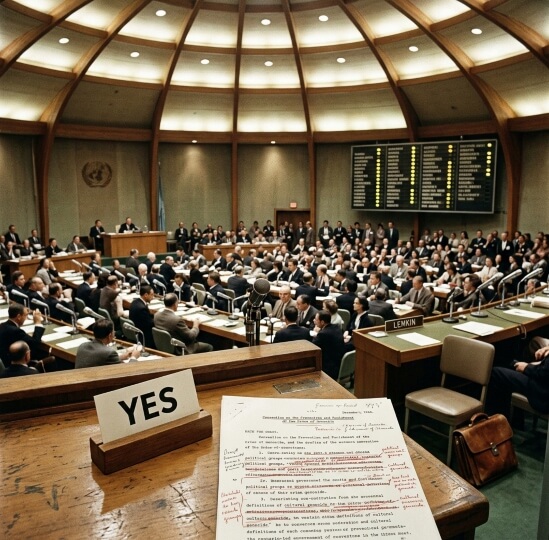
The final text was put to a vote on December 9, 1948. Every delegation present voted in favour – the first unanimous adoption of a human rights treaty in UN history. That timing carries a detail worth noting: the Genocide Convention was adopted the day before the Universal Declaration of Human Rights. The Convention entered into force on January 12, 1951. By February 2025, the number of state parties had reached 153.
A note on Lemkin’s final years
Lemkin spent the last years of his life lobbying governments in New York hotel lobbies, largely without resources. He died on August 28, 1959. Only six people attended his funeral. The United States, his adopted country, did not ratify the Convention during his lifetime. It finally did so in 1988. He wrote near the end: “The fact is that the rain of my work fell on a fallow plain.” He was wrong, but he never knew it.
Canada and the Genocide Convention
Canada ratified the Genocide Convention on September 3, 1952, among the first cohort of Western states to do so. The Convention’s obligations are implemented in Canadian law through several instruments.
Criminal Code Provisions
Section 318 of the Criminal Code makes it an offence to advocate or promote genocide defined as acts falling within Article II of the Convention. Section 319 prohibits the public incitement of hatred against an identifiable group. These provisions have been the subject of Canadian constitutional litigation under the Charter, and have generally been upheld as justifiable limits on freedom of expression.
Crimes Against Humanity and War Crimes Act
The broader framework for prosecuting genocide in Canada is the Crimes Against Humanity and War Crimes Act (S.C. 2000, c. 24), which implements the Rome Statute definition of genocide in Canadian criminal law and establishes extraterritorial jurisdiction. A person accused of genocide, whether or not a Canadian citizen and whether or not the offence occurred in Canada, can be prosecuted in Canadian courts if specific jurisdictional connections exist.
ICJ Jurisdiction
Canada has accepted the compulsory jurisdiction of the International Court of Justice. Article IX of the Genocide Convention provides for mandatory ICJ jurisdiction over disputes between state parties relating to the Convention’s interpretation, application, or fulfilment. This means another state could bring proceedings against Canada before the ICJ if it alleged Canada had failed to prevent or punish genocide. Canada has also submitted declarations under other ICJ jurisdiction clauses.
State Obligations Under the Convention
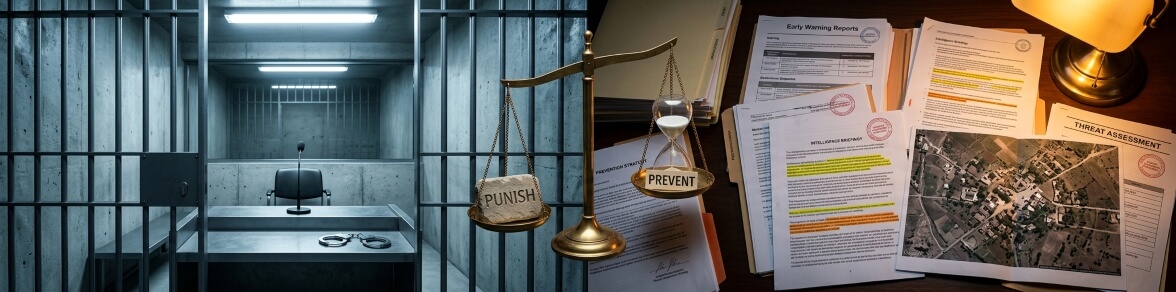
Article 1 of the Convention states that genocide is a crime which state parties “undertake to prevent and punish.” Those two verbs are the source of specific legal obligations, and they are not equally demanding.
The Obligation to Punish
The obligation to punish is more straightforward. States must enact legislation making genocide a criminal offence and must prosecute or extradite persons accused of genocide found in their territory. Crucially, Article IV explicitly removes immunity from prosecution for “constitutionally responsible rulers, public officials or private individuals.” A head of state cannot claim immunity from genocide charges before national courts of states party to the Convention, or before the ICC.
Article VII specifies that genocide is not to be considered a “political crime” for the purposes of extradition. This was specifically designed to prevent states from refusing extradition requests on the grounds that the accused was acting for political reasons.
The Obligation to Prevent
The obligation to prevent is both broader and harder to define. It arises before any genocide occurs, not after. And it does not require that genocide actually happen – a state can breach its obligation to prevent even if the genocide could not have been averted by its actions. The content of that obligation was substantially clarified by the ICJ in 2007.
The ICJ and the Obligation to Prevent: Bosnia v. Serbia (2007)
On February 26, 2007, the International Court of Justice issued its judgment in Application of the Convention on the Prevention and Punishment of the Crime of Genocide (Bosnia and Herzegovina v. Serbia and Montenegro). It was the first time the ICJ had ruled on the merits of a genocide claim between states.
The Court confirmed that the Srebrenica massacre of July 1995, in which approximately 8,000 Bosniak Muslim men and boys were killed by Serbian forces, constituted genocide under Article II. It found Serbia was not directly responsible for committing that genocide, and was not complicit in it. But the Court ruled that Serbia had breached its obligation under Article 1 to prevent the genocide.
The standard it established: a state’s obligation to prevent arises “at the instant that the State learns of, or should normally have learned of, the existence of a serious risk that genocide will be committed.” At that point, the state must “employ all means reasonably available to it to prevent genocide, within the limits permitted by international law.” Serbia, the Court found, was in a position to exert influence over the forces that carried out the Srebrenica killings, knew of the serious risk, and did nothing. That failure was itself a violation of the Convention.
For Canada and other state parties, this judgment has practical implications. Our obligation under Article 1 is not passive. If we have knowledge, or should have knowledge, of a serious risk that genocide will be committed, and we have means available to prevent it, we are required to act. What “means reasonably available” encompasses in any specific situation is a question of fact and law, not a formula. But the duty itself is not optional.
The ICJ in 2007 found Serbia in breach of its duty to prevent the Srebrenica genocide, not for committing it, but for knowing of the serious risk and failing to act. That standard applies to every state party, including Canada.
Genocide vs. Crimes Against Humanity: A Legal Distinction
These two categories are often confused in public discourse, and sometimes used interchangeably. In international criminal law they are distinct. The confusion matters, because the standards for conviction are different.
The Intent Threshold
Genocide requires proof of dolus specialis – a specific intent to destroy the protected group in whole or in part. This is an extremely high evidentiary bar. A prosecutor must show not just that atrocities occurred, but that they were committed with the purpose of eliminating the group.
Crimes against humanity require no such group-destruction intent. They require instead that the acts – murder, torture, forced deportation, sexual violence, and others – be committed as part of a widespread or systematic attack directed against any civilian population. The attack need not target a specific ethnic, national, or religious group at all. And “widespread” refers to scale; “systematic” refers to organization.
Why This Matters in Practice
The ICJ President noted in the Bosnia case that the Court had no jurisdiction to rule on events that may have constituted war crimes or crimes against humanity, because the proceedings dealt “exclusively with genocide in a limited legal sense and not in the broader sense sometimes given to this term.”
In short: every genocide will also constitute crimes against humanity, but not every crime against humanity is genocide. A perpetrator can be convicted of both charges simultaneously for the same conduct. They are not mutually exclusive, but they are legally distinct, and proving genocide requires the additional element of group-destruction intent that crimes against humanity do not.
For asylum seekers and immigration applicants
The Genocide Convention may be relevant to refugee claims in Canada in two ways. First, genocide, or a serious risk of genocide, in a country of origin may constitute grounds for refugee protection under the 1951 Refugee Convention and IRPA. Second, persons who have participated in genocide may be excluded from refugee protection under the exclusion clauses. If your situation involves either question, consult a licensed immigration or refugee lawyer.
Sources: UN Office on Genocide Prevention and the Responsibility to Protect • Facing History & Ourselves (Raphael Lemkin) • National WWII Museum • Genocide Convention Wikipedia (February 2025) • ICJ, Bosnia and Herzegovina v. Serbia and Montenegro, Judgment of 26 February 2007 • HillNotes, “State Recognition of Genocide” (September 2025) • Harvard Human Rights Journal, “Reading Lemkin Today” (June 2025) • Criminal Code of Canada, RSC 1985 c. C-46 • Crimes Against Humanity and War Crimes Act, SC 2000 c. 24