
The Geneva Conventions and Canada
Canada’s Obligations in International Humanitarian Law
Fifty-nine delegations gathered in Geneva that summer. On August 12, 1949, they signed four treaties that would reshape how the world regulates armed conflict. Canada was in the room. What Canada did not do was ratify immediately – sixteen years passed before the federal government deposited its instruments of ratification on May 14, 1965, joining the first cohort of Western states to formalize their commitment after the postwar revision. That commitment was not ceremonial. Ratification attached binding legal obligations to the Canadian state, and those obligations have not diminished since.
This page sets out what the four Conventions require, what the Additional Protocols extended, and what Canada must do, and has done, as a High Contracting Party. One point we address plainly in the FAQ: the Geneva Conventions were a Swiss and humanitarian creation, not a Canadian one. What is distinctly Canadian is our implementing record over sixty years – the legislation, the institutions, the military doctrine – and that record is what this page documents.
Canada and the Geneva Conventions: Ratification and Domestic Law
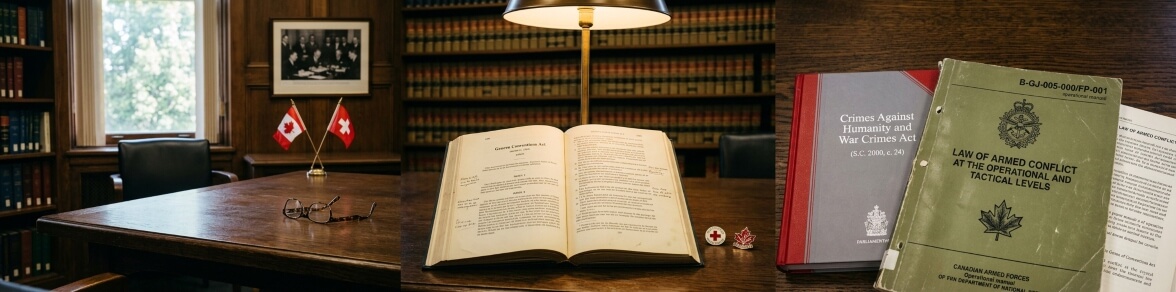
Ratification came on May 14, 1965, bringing all four Conventions into force for Canada, nearly sixteen years after the signing conference closed. Canada returned in 1990 to go further, ratifying Additional Protocol I, which governs international armed conflicts, and Additional Protocol II, which addressed non-international ones for the first time. Protocol III, adding the red crystal alongside the cross and crescent as a recognized protective emblem, followed. For all of these instruments, Switzerland serves as depositary state.
Two statutes carry most of the domestic implementing weight. The Geneva Conventions Act (RSC, 1985, c. G-3) reproduces the full text of all four Conventions and the three Protocols as scheduled annexes. Its section 3(1) converts every grave breach listed in those Conventions into an indictable offence under Canadian criminal law, and does so explicitly “whether within or outside Canada.” Those four words are consequential. They create universal jurisdiction, meaning Canadian courts can try grave breaches regardless of where the offence occurred or who committed it, subject to specified jurisdictional connections.
The Crimes Against Humanity and War Crimes Act (S.C. 2000, c. 24) extended that architecture further. A single statute now implements both the Rome Statute and the Geneva Conventions obligations in Canadian law. It covers war crimes in international and non-international conflicts alike, command responsibility for subordinates’ conduct, and the extraterritorial reach required to prosecute acts committed on foreign soil.
On the institutional side, Canada created a National Committee on International Humanitarian Law in 1998, an inter-ministerial body whose secretariat includes the Canadian Red Cross, to coordinate IHL implementation and public dissemination across five federal departments. The Canadian Armed Forces incorporate the Conventions into operational manuals and professional training at multiple levels. Convention IV, Article 144, makes this dissemination a treaty obligation that runs not just to the military but to the civilian population as a whole.
A distinction worth noting
Canada’s formal ratification came in 1965, but the country had lived with IHL before that. During the Second World War, German and Italian prisoners of war were held on Canadian territory under the 1929 Geneva Convention governing POW treatment – the predecessor instrument to Convention III. When the 1949 Conventions took effect, they replaced and substantially expanded those earlier rules. Canada’s practical acquaintance with IHL obligations therefore predates its formal ratification by at least two decades.
The Four Geneva Conventions: What Each One Covers
The four treaties adopted on August 12, 1949, each address a different category of protected person in armed conflict. Together, they contain more than 400 articles – compared with just 10 in the original 1864 convention. The 1949 revision, convened by Switzerland at the ICRC’s initiative, added the Fourth Convention covering civilians for the first time. It was this civilian protection gap that the horrors of the Second World War had made undeniable.
Convention | Protects | Core obligation |
|---|---|---|
Convention I | Wounded and sick in land warfare | Medical personnel must be respected; wounded must be collected and cared for regardless of side |
Convention II | Wounded, sick and shipwrecked at sea | Extends Convention I to naval warfare; hospital ships protected |
Convention III | Prisoners of war (POWs) | Humane treatment; POWs cannot be tortured or coerced; protections for interrogation |
Convention IV | Civilian persons under enemy control | Occupation rules; protection from deportation, hostage-taking, collective punishment |
All four Conventions are currently party to 196 states making them the most widely ratified international treaties in history. The four Conventions entered into force on October 21, 1950. The Additional Protocols have not achieved that universality: the United States, for instance, has signed but not ratified Protocols I and II.
The four Geneva Conventions of 1949 have 196 state parties, more than any other set of international treaties. In that specific sense, they are universal law.
The Additional Protocols and Their Significance
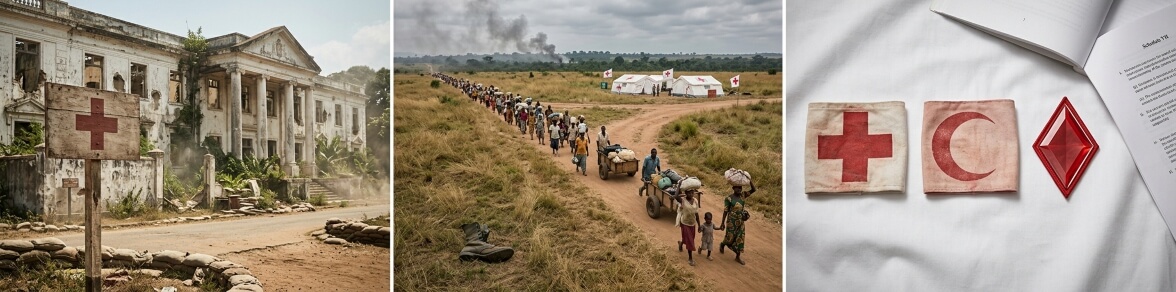
The 1949 Conventions were written primarily with interstate warfare in mind. By the 1970s, that model no longer reflected how wars were actually being fought. Most armed conflicts by that decade were non-international – civil wars, insurgencies, wars of national liberation. Two Additional Protocols, adopted in 1977 after years of ICRC-led negotiations, addressed this gap directly.
Protocol I
Protocol I (1977) strengthened protections for victims of international armed conflicts. Crucially, it extended the definition of international conflict to include wars of national liberation against colonial domination – a politically contested addition that contributed to the US declining to ratify it. It also elaborated rules on the conduct of hostilities: the prohibition on indiscriminate attacks, the principle of proportionality, and protections for the natural environment in wartime. Canada ratified Protocol I in 1990.
Protocol II
Protocol II (1977) was a breakthrough. It was the first treaty devoted entirely to non-international armed conflicts, civil wars. Earlier IHL, including the 1949 Conventions, had only touched this through Common Article 3. Protocol II significantly expanded those protections: it prohibits attacks on civilians, forced movement of civilians, and starvation as a method of combat. Canada ratified Protocol II in 1990 as well.
Protocol III
Protocol III (2005) added the red crystal as a third recognized protective emblem, alongside the red cross and the red crescent. This resolved a long-standing dispute over religious connotations. Canada ratified Protocol III. The emblem is set out in Schedule VII of Canada’s Geneva Conventions Act.
Core Protections Under the Geneva Conventions
The single most important provision across all four Conventions is Common Article 3, so called because the identical text appears in all four treaties. Its adoption in 1949 was a genuine breakthrough: for the first time, an IHL treaty applied to non-international armed conflicts. Article 3 establishes minimum protections for all persons taking no active part in hostilities, including wounded fighters and those detained, regardless of which side they fought on.
Those minimum protections prohibit: murder; mutilation and cruel treatment; torture; hostage-taking; humiliating and degrading treatment; and sentences passed without judicial guarantees. These prohibitions apply in all circumstances. There is no derogation clause, no exception for military necessity. That absoluteness is precisely the point.
Beyond Common Article 3, the Conventions establish the category of grave breaches, the most serious violations, which states are obligated to prosecute or extradite. Grave breaches include willful killing of protected persons, torture or inhumane treatment, unlawful deportation, taking hostages, and extensive destruction of property not justified by military necessity. These form the core of what we understand today as war crimes in international armed conflict. Canada’s Geneva Conventions Act, s. 3(1), makes every grave breach listed in each of the four Conventions an indictable offence under Canadian law.
The concept of protected persons runs through all four Conventions. It covers: the wounded and sick (Conventions I and II); prisoners of war (Convention III); and civilians in the hands of an adverse party or under occupation (Convention IV). Protection is conditional on status, but status is to be determined by a competent tribunal where any doubt exists, not by the detaining power’s unilateral judgment.
Who Enforces the Geneva Conventions?
This is where international humanitarian law and international criminal law overlap, and where the limits become visible. The Conventions themselves rely primarily on state enforcement: each High Contracting Party is obligated to enact legislation making grave breaches a criminal offence and to prosecute or extradite alleged perpetrators. That is the architecture we inherited from 1949. It still works, imperfectly.
The ICRC plays a specific role under the Conventions that is unlike any other international body. It has a right of access to prisoners of war and civilian internees – a right no other organization holds by treaty. Its delegates may visit places of detention, interview protected persons without witnesses, and report their findings to the detaining power. The ICRC’s reports are confidential. That confidentiality is deliberate: it preserves access.
The International Criminal Court now has jurisdiction over war crimes, including grave breaches of the Geneva Conventions, committed in the territory of, or by nationals of, states party to the Rome Statute. Canada ratified the Rome Statute in 2000. But the ICC’s jurisdiction is complementary: it acts only when national courts are unwilling or unable to prosecute. Our own Crimes Against Humanity and War Crimes Act is designed to ensure Canada remains able.
There is also the institution of Protecting Powers – a neutral state accepted by both parties to a conflict to monitor compliance. This mechanism functioned in the Second World War but has rarely been used since. It remains in the treaty text.
Canada’s Obligations as a High Contracting Party
Ratification created a set of specific, ongoing obligations for Canada. They do not arise only during armed conflict, some apply in peacetime.
- Dissemination. Canada must ensure that the text and principles of the Conventions are as widely known as possible, in both the armed forces and among the civilian population. The Geneva Conventions Act and Canada’s National Committee on IHL serve this function.
- Military training. Canadian Armed Forces operations manuals incorporate IHL, and training on the laws of armed conflict is a standard element of CAF professional development. Canada’s IHL implementation report to the UN confirms this.
- Investigation and prosecution. Canada is required to search for, prosecute or extradite persons alleged to have committed grave breaches, regardless of nationality or where the offence occurred. Section 3 of the Geneva Conventions Act and section 6 of the Crimes Against Humanity and War Crimes Act give Canadian courts the jurisdiction to do so.
- Emblem protection. Canada must pass and enforce laws protecting the red cross, red crescent, and red crystal emblems from unauthorized use. Misuse of these emblems in armed conflict is itself a war crime.
Canada’s Geneva Conventions Act establishes that grave breaches are criminal offences under Canadian law, “whether within or outside Canada.” That four-word phrase is the legal basis for universal jurisdiction in Canadian courts over war crimes.
Frequently Asked Questions
No. The Geneva Conventions were created by Switzerland and the International Committee of the Red Cross, a Swiss institution. Henry Dunant, a citizen of Geneva, witnessed the Battle of Solferino in 1859 and founded the ICRC in 1863. Switzerland convened the 1864 conference that produced the first Geneva Convention. Canada played no founding role. Our contribution is as an active ratifying state that implemented the Conventions in domestic law earlier than most, which is a different thing.
The immediate cause was Solferino. By the mid-19th century, the industrialization of warfare was producing casualties faster than any organized system could treat them. Dunant’s insight was that a neutral institution and a binding legal agreement could fix this. The 1864 convention began with one obligation: care for the wounded, on both sides. The 1949 revision expanded that principle into new categories of victims – prisoners of war, civilians, the shipwrecked.
Yes, fully. Canada has been a High Contracting Party since 1965. The obligations are implemented domestically through the Geneva Conventions Act (RSC, 1985, c. G-3) and the Crimes Against Humanity and War Crimes Act (SC 2000, c. 24). Grave breaches committed by or against Canadian nationals anywhere in the world can be prosecuted in Canadian courts.
Sources: Canada.ca Human Rights Treaties • Geneva Conventions Act RSC 1985 c. G-3 (Justice Canada) • Crimes Against Humanity and War Crimes Act SC 2000 c. 24 (Justice Canada) • ICRC • ICRC History (icrc.org) • Canadian Red Cross – IHL in Canada • House of Switzerland • UN Sixth Committee, Canada IHL Status Report