
Does Canada’s Digital Privacy Framework Meet Its ICCPR Obligations?
Article 17, PIPEDA, and the Proportionality Problem in a Data-Intensive Economy
When Canada acceded to the International Covenant on Civil and Political Rights in May 1976, the digital age was a remote abstraction. Article 17, the Covenant’s guarantee against arbitrary or unlawful interference with privacy, family, home, or correspondence, was drafted with mid-twentieth-century intrusions in mind: postal interception, arbitrary home searches, state surveillance.
Nearly half a century later, the same language must be applied to a world in which intimate personal data is generated continuously, collected by default, and transferred across borders in milliseconds. Whether Canada’s domestic privacy framework satisfies its ICCPR obligations is no longer a theoretical question.
Article 17 of the ICCPR: The Binding Standard
Article 17 imposes two distinct duties. First, every interference with privacy must be lawful grounded in a publicly accessible legal rule precise enough to allow individuals to regulate their conduct. Second, the interference must not be arbitrary. It must be necessary and proportionate to a legitimate aim. The Human Rights Committee’s General Comment No. 16 makes clear that states parties bear positive obligations to protect individuals from interferences by private actors as well as the state, and that privacy protections must be enforceable in practice.
The Committee’s jurisprudence gives consistent guidance on what fails. Laws granting unfettered discretion to officials or private entities fail the legality test. Collection of more personal information than is strictly necessary fails proportionality. The requirement of independent oversight recurs across decisions. In the digital context, where personal information is processed by algorithms and shared among multiple commercial entities, the state’s duty to establish a framework meeting Article 17’s standard is particularly acute.

Canada’s Domestic Privacy Architecture
Canada’s principal private-sector privacy statute is the Personal Information Protection and Electronic Documents Act (PIPEDA), in force since 2001. It applies to commercial activity nationally except where substantially similar provincial legislation exists – Quebec, British Columbia, and Alberta. PIPEDA’s model is consent-based: organisations must obtain meaningful consent and limit collection to what is necessary.
In practice, the framework has significant weaknesses. Consent has become, in the words of successive Privacy Commissioners, an illusion – policies are opaque, take-it-or-leave-it, and rarely read. Enforcement relies on non-binding recommendations; Federal Court orders are slow and resource-intensive.
Bill C-27, introduced in 2022 to replace PIPEDA with the Consumer Privacy Protection Act, has not yet become law. Even if passed, its provisions fall short of the EU GDPR model: absent are a right to object to profiling, mandatory privacy impact assessments, and an independent order-making authority capable of responding quickly to systemic violations.
A legal regime that permits the routine extraction of highly sensitive personal data as a condition of accessing a legally provided service, without genuine independent oversight or an effective individual remedy, sits uncomfortably beside the plain text of Article 17 and General Comment No. 16.
The iGaming Stress Test: Do Ontario’s Online Casinos Meet Article 17 Standards?
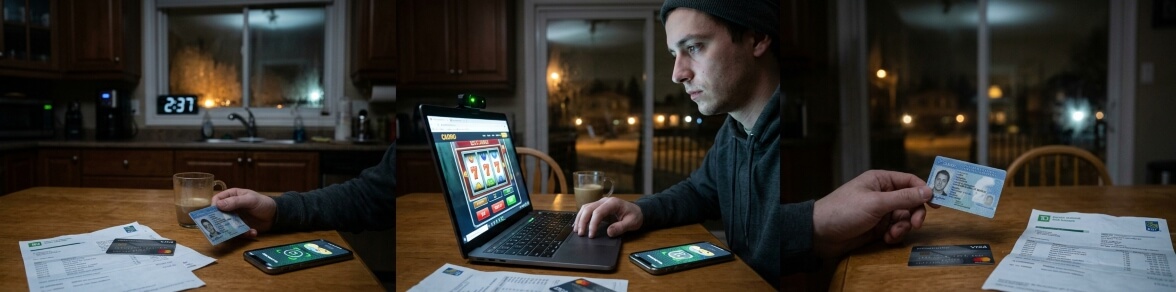
To assess whether the framework meets Article 17’s standards outside pure theory, it is useful to examine a sector that operates under a specific regulatory mandate and collects deeply personal data as a condition of participation. Ontario’s legal online gambling market, launched in April 2022, is an instructive case.
When a resident of Ontario registers with a licensed online casino, the operator must comply with standards set by the Alcohol and Gaming Commission of Ontario (AGCO) and federal anti-money-laundering requirements under FINTRAC. Identity verification is mandatory: government-issued identification, proof of address, and often biometric facial recognition through a third-party service. Geolocation software runs continuously during a session to confirm the user remains within the province. Every deposit, wager, and withdrawal is logged and analysed by automated systems designed to detect problem gambling behaviour. Operators may also conduct affordability checks by accessing credit bureau data or requiring bank statements.
This constellation of data – identity, precise location, financial transactions, behavioural patterns, and inferences about mental health – is about as sensitive as commercial data can be. Much of it is processed not by the operator directly but by platform and software providers, many headquartered outside Canada, under contractual arrangements the player never sees.
A player who wishes to use an Ontario-licensed online casino has no option to decline this surveillance. Consent is a condition of entry. The ICCPR requires that privacy limitations be the least intrusive option available. Whether continuous real-time monitoring of every click and betting pattern, rather than, for example, self-exclusion programmes, player-set spending caps, or independent counselling, meets that standard is, at minimum, open to serious legal doubt.
What Article 17 asks
The ICCPR does not prohibit surveillance. It requires that surveillance be lawful, necessary, and proportionate. Where a less intrusive means can achieve the same legitimate aim, the more intrusive option cannot be justified. That test applies equally to state agencies and to privately operated services that the state has licensed and whose data practices it has the power to regulate.
Cross-Border Data Flows and ICCPR Jurisdiction
The transnational dimension compounds the concern. ICCPR obligations are not limited by geography; they attach to individuals within Canada’s jurisdiction. When a Canadian resident’s data is stored on a cloud server in another country and processed by a foreign subcontractor, Canada retains the human rights duty to ensure that the domestic framework provides adequate, enforceable protection.
PIPEDA addresses cross-border flows through a principle of accountability: the transferring organisation remains responsible and must use contractual means to provide comparable protection. Whether contractual clauses between private commercial actors can satisfy the state’s positive obligation under a binding human rights treaty, especially when the transferee is subject to a foreign government’s lawful access powers that may not meet international human rights standards, is an unresolved tension.
Committee Scrutiny: What the UN Has Said About Digital Privacy
In its 2015 concluding observations, the Human Rights Committee flagged concerns about information-sharing under Canada’s Anti-terrorism Act and inadequate oversight of surveillance activities, recommending that all privacy interferences meet the principles of legality, necessity, and proportionality.
Canada’s seventh ICCPR review took place on March 3–4, 2026. More than 80 civil society organizations submitted shadow reports covering digital privacy concerns: no general right to object to automated decision-making, data-intensive commercial practices, and Canada’s failure to ratify the modernised Council of Europe Convention 108+. The Committee’s concluding observations, expected later in 2026, will indicate how the international community assesses the gap between Canada’s framework and its Article 17 duties.
From Consumer Protection to Human Rights Compliance
The essential difficulty is framing. Canadian law treats commercial privacy as a consumer protection matter rather than a fundamental right enforceable against the state. The ICCPR draws no such distinction: the state is answerable for the entire legal environment it creates, not only for direct government action.
Ontario’s regulated online casinos illustrate the structural problem. This is a market explicitly authorised and licensed by the state. If that licensing framework permits privacy interferences that cannot be justified as necessary and proportionate, the responsibility under the ICCPR rests with Canada. The solution is not less regulation. It is embedding Covenant standards directly into how data-intensive services are authorised.
Public privacy impact assessments, a necessity test applied to each category of personal information collected, and a binding remedy mechanism are not radical demands. They are what Article 17, read faithfully, requires. Until they exist, the answer to whether Canada’s framework meets its ICCPR obligations is a carefully qualified “not yet.”
Sources: UN Human Rights Committee, General Comment No. 16 (1988) • OHCHR Treaty Body Database, Canada’s Sixth Periodic Review under the ICCPR (2015) • Personal Information Protection and Electronic Documents Act (S.C. 2000, c. 5) • Bill C-27, Digital Charter Implementation Act, 2022 • Alcohol and Gaming Commission of Ontario, Registrar’s Standards for Internet Gaming • FINTRAC, Obligations for casinos • Canadian Civil Liberties Association, Shadow Report to the Human Rights Committee (2026) • Office of the Privacy Commissioner of Canada, Annual Reports (2022–2025)